





Open Dollar is a stablecoin protocol built on Arbitrum designed to help you safely and predictably profit and leverage your assets.
Liquid Staking Tokens (LST) and other assets created on Arbitrum can be placed in Non-Fungible Vaults (NFV) to borrow OD stable coins with low-interest loans, create leveraged positions, and continue to earn 100% of your staking yield. OD is over-collateralized and pegged to $1.00 with a dynamic reward system.
Open Dollar's NFV is a more efficient account-linked CDP alternative that gives depositors the ability to trade their positions or sell them to arbitrageurs on any NFT platform without fully repaying loans or incurring liquidation penalties.
Open Dollar's minimally managed approach ensures the longevity and fairness of the platform. A DAO governed by an Open Dollar Governance (ODG) token can vote to add new types of collateral, but is otherwise limited and can't mint new OD tokens or change parameters such as fee distribution.
How OD stablecoin works
OD is a stable over-collateralized asset with a managed float regime. The exchange rate of OD to the US dollar is determined by supply and demand, and the protocol that issues OD tries to stabilize its price by constantly de- or revaluing it.
The supply and demand mechanism operates between two parties: vault users (those who generate OD with their collateral tokens) and OD holders.
Compared to protocols that attempt to maintain a fixed exchange rate between their native stable asset (pegged coin), OD monetary policy has several advantages:
- Flexibility: the protocol can devalue or revalue OD in response to changes in the market price of OD. This process transfers value between vault users and OD holders and incentivizes both parties to return the market price to the target value chosen by the protocol. This mechanism is similar to how countries devalue or revalue their currencies to combat trade imbalances. In the case of OD, the “trade imbalance” occurs between OD and the users of the repository.
- Discretion: the protocol itself is free to change the target exchange rate in its favor. It can attract or repel capital whenever it wants.
At the same time, a managed floating exchange rate can cause uncertainty because the price changes from day to day.
OD Borrowing
The Open Dollar platform makes it easy to borrow stable OD coins against your LSTs or other Arbitrum-supported assets and create leveraged positions at low rates, keeping 100% of the return on the pledged collateral.
A unique feature of the is the implementation of non-fungible vaults (NFVs) that allow you to transfer, exchange or sell the entire position without repaying the outstanding loan.
When you first connect your wallet to the Open Dollar app, you will be prompted to create a Vault Facilitator. Signing this transaction will allow you to create new vaults.
The amount of OD you can borrow depends on the minimum collateralization ratio (MCR) of your deposited assets.
This ensures that the minted ODs are sufficiently collateralized, maintaining the stability and security of the protocol.
There are three types of auctions in the Open Dollar protocol:
- Collateral Auctions
- Surplus Auctions
- Debt Auctions
These auctions occur automatically in the event of a vault liquidation, OD surplus, or ODG surplus, providing users with incentives and opportunities to take actions that support the health of the protocol.
These auctions are an important mechanism to ensure an orderly and fair sale of collateral to cover any outstanding obligations, allowing participants to bid on assets, thereby contributing to the stability and liquidity of the protocol.
If the value of the collateral in the vault falls below the MCR, liquidation may occur. This process protects the protocol from insolvency risks.
When a vault is liquidated, the collateral is lost because it is used to pay off the account. The vault owner will no longer be able to recover the collateral by paying off the debt. The penalty for liquidation depends on the type of collateral and is specified when the vault is opened.
NFT Vaults (NFVs)
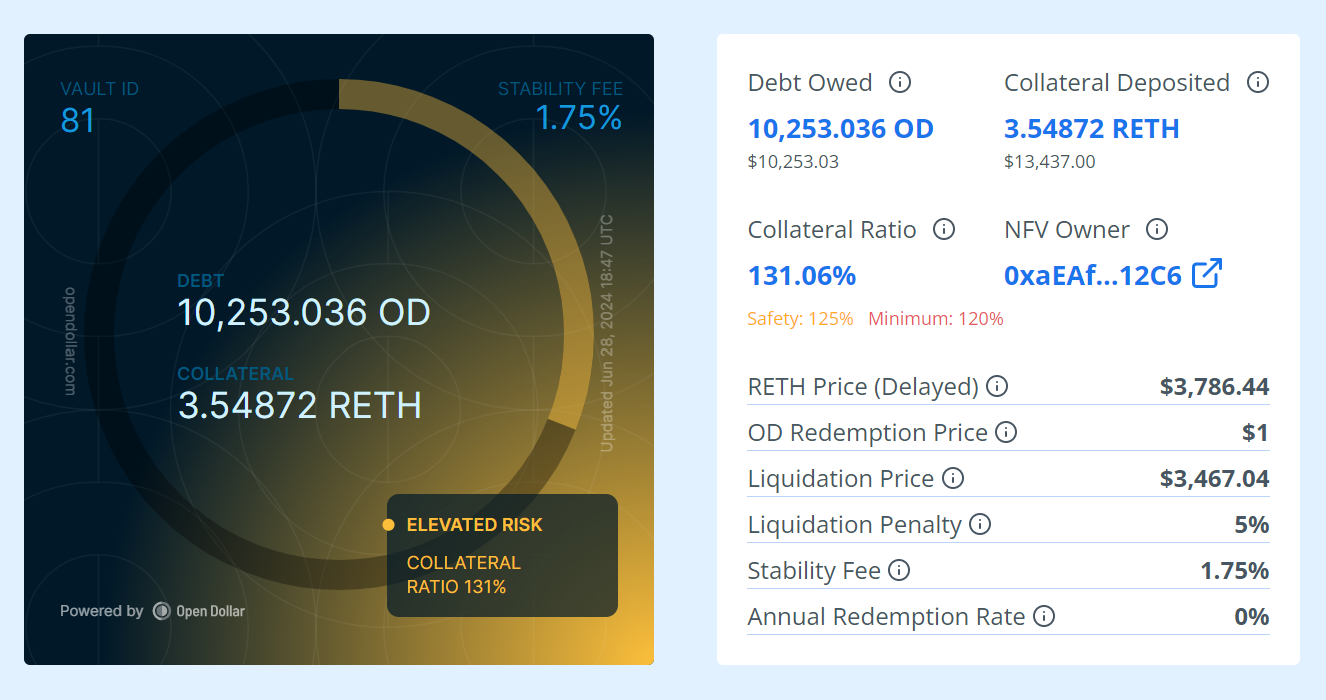
In Open Dollar, vaults are represented as NFTs, making each vault separate and transferable. Unlike traditional CDPs, where ownership is tied to an account, Open Dollar uses NFVs that tie ownership of collateral and debt to the NFT.
Features
- ERC-721 standard: NFVs are compatible with all blockchain wallets and NFT trading platforms that support the ERC-721 standard.
- Dynamic image and metadata display: NFV images show the current status, state, pledge and debt of the vault with time updates, and are displayed entirely on the blockchain.
- Direct wallet management: Users can directly manage and track their CDPs from their wallets, bypassing the need to interact with the front-end of the protocol.
- Composability and Cross-Chain Capability: Facilitates batch transfers and asset ownership transfers, and enables efficient cross-chain interoperability.
- Enhanced visibility and tracking: Integrates with wallet aggregators and portfolio trackers for dynamic pricing and up-to-date information.
Benefits
- Transferability and liquidity: NFVs make CDPs transferable and liquid, allowing them to be traded on the open market.
- Capital Efficiency and Accessibility: NFVs offer a capital-efficient solution by automating the sale of vaults to avoid liquidation penalties.
- Improved treasury and risk management: Promotes improved treasury management, risk assessment and performance tracking.
- Security benefits: Integrates with compliance and escrow services to enhance protection against bad participants.
Leverage
Leveraging a vault position involves using borrowed funds to purchase more of a collateralized asset in order to increase returns. This process may be repeated several times until the desired values are achieved. With each leverage step, a number of key metrics change, usually in the same direction as the first step.
As additional collateral is acquired through additional borrowing, the net yield, liquidation threshold and leverage ratio increase, as well as the total value of the collateral and outstanding debt. The amount available for borrowing decreases at each stage due to the minimum collateralization ratio requirement of 125%, which limits the borrowing capacity to 80% of the value of the additional collateral at each stage. In addition, the overall collateralization ratio decreases as the amount of debt increases relative to the amount of collateral.